What Is Cortisol Belly? Stress, Abdominal Fat, and Where Ashwagandha Fits
The phrase "cortisol belly" is everywhere. It appears in videos about unexplained weight gain, advertisements for stress supplements, and lists of symptoms that seem to turn an ordinary hormone into the cause of nearly every frustrating change in the body.
The reality is less dramatic and more useful.
Cortisol does influence metabolism, appetite, blood sugar, and how the body responds to stress. Long-term cortisol excess caused by a medical condition can change fat distribution. Everyday psychological stress may also affect eating, sleep, movement, and metabolic health. But a person’s waistline cannot reveal their cortisol level, and "cortisol belly" is not a medical diagnosis.
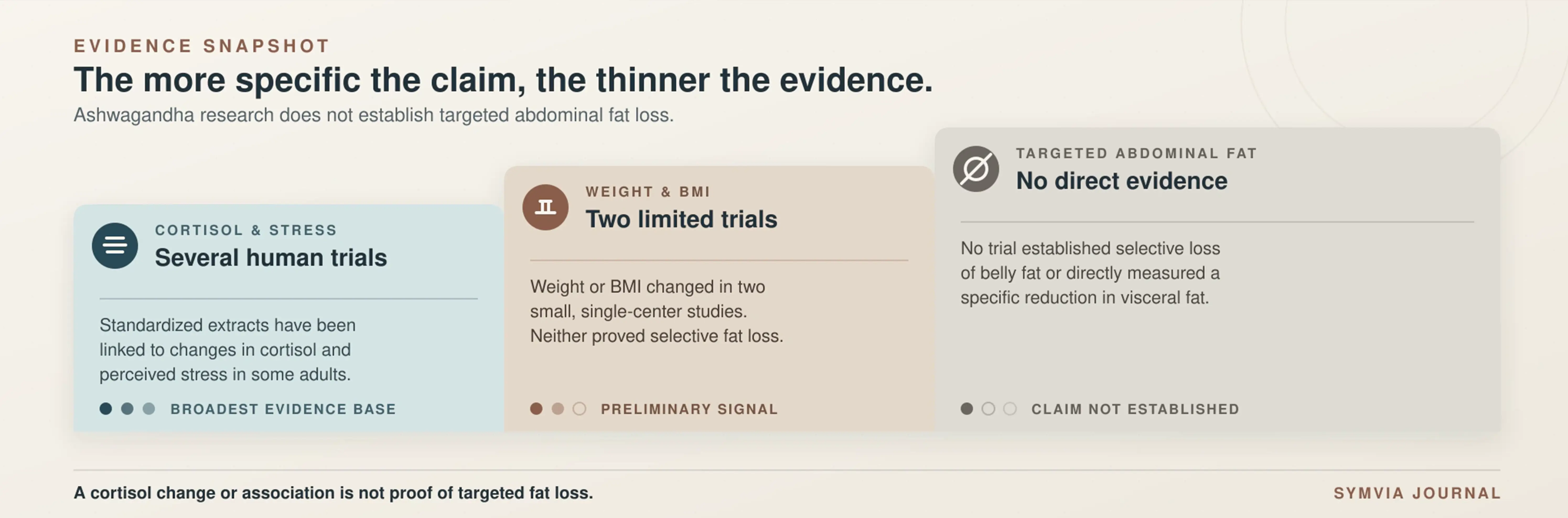
That distinction matters when discussing ashwagandha. Research suggests that certain standardized ashwagandha extracts may affect cortisol and perceived stress in some adults. A much narrower body of research has also examined body weight and food cravings. None of it proves that ashwagandha selectively removes abdominal fat or treats a condition called cortisol belly.
The short answer
Does ashwagandha reduce cortisol belly? There is not enough evidence to say that it does.
Several studies have associated standardized ashwagandha extracts with changes in cortisol, stress scores, food cravings, body weight, or body mass index. However, the studies did not establish that ashwagandha specifically reduces visceral fat, targets fat around the waist, or produces weight loss by lowering cortisol. Most were small, used different extracts and methods, and measured outcomes over weeks or months rather than after a single dose.
Ashwagandha may have a place in a broader stress-management routine for some adults. It should not be framed as a targeted belly-fat solution.
For a closer look at the hormone research itself, read Ashwagandha and Cortisol: Can This Ancient Herb Help Manage Stress? .
What does "cortisol belly" actually mean?
"Cortisol belly" is a popular wellness term used to describe abdominal weight gain that is assumed to result from stress or elevated cortisol. It is not a diagnosis recognized in endocrinology, and there is no single body shape that proves a person has too much cortisol.
Cortisol is a steroid hormone produced by the adrenal glands. It helps regulate energy availability, blood pressure, immune activity, and the sleep-wake cycle. Levels normally rise and fall throughout the day. They are usually higher around waking and lower near bedtime. A temporary rise during a demanding situation is part of a healthy stress response, not evidence that something is wrong.
The problem with the phrase cortisol belly is that it compresses a complicated system into a simple visual story: stress raises cortisol, cortisol creates belly fat, and lowering cortisol removes it. Human physiology does not work that neatly.
Is cortisol connected to abdominal fat?
There is a connection, but it is not a one-way switch.
In Cushing’s syndrome, prolonged exposure to unusually high cortisol can cause weight gain and characteristic changes in fat distribution. The condition is rare and typically involves a broader pattern of progressive signs, which may include thinner arms and legs, muscle weakness, easy bruising, wide purple stretch marks, a rounder face, and increased fat around the neck or between the shoulders. [1]
That medical condition is different from ordinary daily stress.
Research on psychological stress, cortisol, and body fat is mixed. A meta-analysis of longitudinal studies found a statistically significant association between stress and increasing adiposity, but the overall effect was very small. Most of the individual analyses found no significant relationship. [2] A separate systematic review found that greater abdominal fat was often associated with differences in the body’s stress-response system, including cortisol awakening and stress reactivity. The authors also emphasized that results varied by the way cortisol and body fat were measured. [3]
Those findings support a relationship. They do not prove that cortisol alone caused the abdominal fat. The relationship may also work in both directions, with body composition influencing cortisol metabolism and stress physiology.
Stress can affect body weight through several overlapping pathways:
- Sleep may become shorter or less consistent.
- Food cravings and emotional eating may change.
- People may move less during demanding periods.
- Alcohol intake or meal patterns may shift.
- Cortisol and other metabolic signals may influence appetite and energy use.
Focusing on cortisol alone can hide the behaviors, environment, genetics, medications, sleep patterns, and health conditions that also shape body composition.

Can you tell whether cortisol is high by looking at your stomach?
No. Abdominal weight gain by itself cannot diagnose high cortisol.
Many common factors can affect the waist, including total weight change, age, genetics, sleep, activity, nutrition, menopause, alcohol use, medications, and metabolic health. Even symptoms such as fatigue, difficulty sleeping, or weight gain have many possible causes.
When clinicians suspect Cushing’s syndrome, they do not diagnose it from appearance or from a random online symptom list. The Endocrine Society recommends validated tests such as late-night salivary cortisol, 24-hour urinary free cortisol, or a dexamethasone suppression test in appropriate patients. It recommends against using a random serum cortisol result as a screening test. [8]
Someone with multiple progressive features of cortisol excess, especially unusual bruising, wide purple stretch marks, marked muscle weakness, or new health problems that seem unusual for their age, should discuss them with a qualified healthcare professional. A supplement is not a substitute for an appropriate medical evaluation.
Where does ashwagandha fit?
Ashwagandha has been studied more directly for stress and cortisol than for abdominal fat.
A 2025 systematic review and meta-analysis combined seven randomized trials that measured cortisol in 488 adults. The pooled result found a statistically significant reduction in cortisol with ashwagandha. However, the same analysis did not find a statistically significant improvement in perceived stress scores. All included trials were conducted in India, risk of bias was generally moderate, and the studies differed in extract, dosage, duration, and participants. [4]
That result is a good example of why a biomarker and a lived experience should not be treated as interchangeable. A change in a cortisol measurement does not automatically mean a person feels calmer, loses weight, or loses fat from a particular area.
For more detail on the extracts, trial designs, and limitations, see our full review of ashwagandha and cortisol .
What do the weight-management studies show?
Two randomized trials deserve attention, but neither proves a targeted effect on abdominal fat.
In a small eight-week study published in 2017, 52 adults experiencing chronic stress received either 300 milligrams of KSM-66 ashwagandha root extract twice daily or a placebo. The ashwagandha group showed greater improvements in perceived stress, food cravings, serum cortisol, body weight, and body mass index. The study used a standardized root extract and a placebo-controlled design, but it was conducted at one center, included only 50 participants in the efficacy analysis, and treated body weight and BMI as secondary outcomes. It did not measure waist circumference, visceral fat by imaging, or selective abdominal fat loss. [5]
A newer 24-week randomized study published in 2025 included 100 adults with overweight or obesity. Participants received the same daily amount of a standardized root extract or placebo. The researchers reported greater reductions in body weight, BMI, perceived stress, food cravings, and serum cortisol in the ashwagandha group. The study is notable because it was longer and made weight change a primary outcome. It was still a single-center trial, lifestyle factors were not tightly monitored, and it did not establish that any weight change came specifically from lower cortisol or from a selective reduction in abdominal fat. [6]
These trials are signals worth studying further. They are not enough to classify ashwagandha as a proven weight-loss ingredient, and they do not validate the phrase cortisol belly.
Does ashwagandha lower cortisol immediately?
Ashwagandha has not been established as an immediate cortisol-lowering intervention.
The relevant clinical studies generally used the ingredient every day and measured outcomes after several weeks. Even when a study finds a difference at the end of a trial, that does not tell us the exact day a benefit began or whether one serving produced an acute effect.
This is one reason the language of routines and consistency is more accurate than the language of quick fixes. Research on ashwagandha reflects repeated use of a specific extract under controlled conditions. It does not support taking it occasionally to cancel a stressful day or a particular meal.
Should ashwagandha be taken every day?
Most clinical trials have used daily dosing, but that does not mean daily ashwagandha is appropriate for everyone or should continue indefinitely.
The National Center for Complementary and Integrative Health states that some ashwagandha preparations may be safe for short-term use, up to about three months, while evidence is insufficient to draw conclusions about long-term safety. Possible side effects include drowsiness and digestive upset. Rare cases of liver injury have been reported. Ashwagandha should be avoided during pregnancy and breastfeeding, and it may be unsuitable for people with certain thyroid or autoimmune conditions or for those taking medications that can interact with it. [7]
The extract matters, too. Results from a trial involving one standardized extract cannot automatically be applied to every powder, gummy, capsule, tincture, or formula labeled ashwagandha.
A more useful way to think about stress and body composition
If stress is affecting sleep, appetite, recovery, or daily habits, the most useful response is rarely to chase one hormone.
A better approach is to look at the full pattern:
- Is sleep regular enough to support recovery?
- Are meals satisfying and built around nutrient-dense foods?
- Is movement consistent, including both walking and resistance exercise?
- Is alcohol making sleep or appetite harder to regulate?
- Are there realistic periods of decompression during the day?
- Could a medication or health condition be contributing to the change?
These questions are less marketable than a cortisol detox, but they are more aligned with how the body actually works.
Ashwagandha may be one supportive ingredient within that larger picture for some adults. The evidence is most relevant to stress-related outcomes, and even there, results depend on the extract, dose, population, and study design. It should not carry the full weight of a person’s stress strategy or body-composition goals.

The bottom line
"Cortisol belly" gives a simple name to a complicated concern, but it can also encourage people to diagnose themselves from appearance and expect one supplement to solve the problem.
Cortisol is connected to metabolism and the stress response. Severe, sustained cortisol excess can change body composition, while ordinary stress may influence weight through sleep, appetite, behavior, and physiology. Those facts do not make all abdominal fat a cortisol disorder.
Ashwagandha research offers an interesting but limited signal. Standardized extracts have been associated with lower cortisol in some trials, and two studies reported changes in body weight or BMI. No convincing evidence shows that ashwagandha specifically reduces belly fat, targets visceral fat, or treats a condition called cortisol belly.
The better goal is not to eliminate cortisol. It is to build a healthier rhythm between effort and recovery.
Frequently Asked Questions
- Does ashwagandha reduce cortisol belly?
- There is no strong evidence that ashwagandha selectively reduces abdominal or visceral fat. Some trials have reported changes in cortisol, stress, food cravings, body weight, or BMI, but they did not establish targeted belly-fat loss.
- Is cortisol belly a real medical condition?
- No. Cortisol belly is a popular wellness phrase, not a medical diagnosis. Abdominal weight gain can have many causes and cannot be used by itself to determine a person’s cortisol level.
- Can stress make you gain belly fat?
- Stress may contribute to weight change through sleep disruption, appetite, food choices, activity, and stress physiology. Research shows an association between stress and adiposity, but the average effect is small and varies considerably between people.
- How quickly does ashwagandha reduce cortisol?
- Clinical trials generally measure outcomes after several weeks of consistent use. They do not establish that ashwagandha immediately lowers cortisol or identify one reliable point when an effect begins.
- What are warning signs of medically high cortisol?
- Long-term cortisol excess can cause a progressive cluster of features, including muscle weakness, easy bruising, wide purple stretch marks, thinner limbs, a rounder face, and changes in fat distribution. These signs are not specific enough for self-diagnosis. A clinician can determine whether testing is appropriate.
- Can you flush cortisol out of your system?
- No. Cortisol is an essential hormone that the body produces and regulates throughout the day. It is not a toxin that needs to be flushed out. The goal is healthy regulation, not elimination.
Sources
- National Institute of Diabetes and Digestive and Kidney Diseases. Cushing’s Syndrome. National Institutes of Health.
- Wardle J, Chida Y, Gibson EL, Whitaker KL, Steptoe A. Stress and adiposity: a meta-analysis of longitudinal studies. Obesity. 2011;19(4):771-778.
- Incollingo Rodriguez AC, Epel ES, White ML, Standen EC, Seckl JR, Tomiyama AJ. Hypothalamic-pituitary-adrenal axis dysregulation and cortisol activity in obesity: a systematic review. Psychoneuroendocrinology. 2015;62:301-318.
- Albalawi AA. Dual impact of Ashwagandha: significant cortisol reduction but no effects on perceived stress, a systematic review and meta-analysis. Nutrition and Health. 2025;31(4):1395-1408.
- Choudhary D, Bhattacharyya S, Joshi K. Body weight management in adults under chronic stress through treatment with Ashwagandha root extract: a double-blind, randomized, placebo-controlled trial. Journal of Evidence-Based Complementary and Alternative Medicine. 2017;22(1):96-106.
- Pakhale K, Pakhale R, Srivathsan M, Langade J, Langade D. Efficacy and safety of Ashwagandha root extract on stress and weight management in adults: a prospective, randomized, double-blind, placebo-controlled study. Journal of Medicine and Life. 2025;18(12):1140-1154.
- National Center for Complementary and Integrative Health. Ashwagandha: Usefulness and Safety. National Institutes of Health.
- Endocrine Society. Diagnosis of Cushing’s Syndrome Guideline Resources.